 By
·
5 minute read
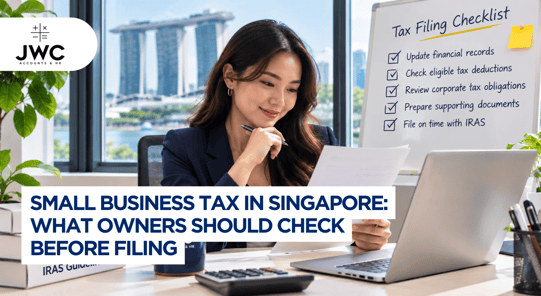
Tax season has a way of exposing the little things that have been put off: an expense with no receipt, a bank account that has not been reconciled, or a tax deadline that suddenly feels much closer than expected.
For a small business owner, tax filing is rarely the only thing on the to-do list. But getting it right matters. Good preparation helps you understand what your business owes, support the figures you report and avoid unnecessary back-and-forth when IRAS asks for clarification.
The good news? You do not need a complicated process to get started. A few consistent habits can make tax filing much more manageable. Here are five practical tips to keep in mind.
1. Know Which Tax Return Applies to Your Business
Before you start gathering documents, make sure you know what you are filing. In Singapore, the process depends on how your business is set up.
If your business is incorporated as a company, you will generally need to consider two corporate income tax filings: Estimated Chargeable Income (ECI) and the annual Corporate Income Tax Return. ECI is generally due within three months after the end of your financial year, unless your company qualifies for the filing waiver or is specifically not required to file. The annual Form C-S, Form C-S (Lite) or Form C is generally due by 30 November each year.
Not every company uses the same form. Form C-S (Lite) is available to qualifying companies with annual revenue of S$200,000 or below. Form C-S has its own eligibility conditions, while companies that do not qualify for the simplified returns generally file Form C.
If you operate as a sole proprietor or in a partnership, your business income is generally reported through the relevant individual income tax process instead. Do not assume that the corporate filing rules apply to every business structure.
A quick check of your entity type and IRAS filing notices can save you from preparing the wrong return.
2. Keep Your Bookkeeping Up to Date, Not Just at Year-End
Trying to reconstruct a full year of transactions just before filing is a headache most business owners can do without. It is also when missing invoices, duplicate entries and unexplained bank transactions are more likely to slip through.
Set aside time each month to update your books. Match bank transactions to your accounting records, record sales and supplier invoices, review outstanding customer payments, and check that expenses have been assigned to the right categories.
A monthly review does not need to take all day. The important thing is to make it a routine. When the financial year closes, you will have a much clearer picture of your business performance and fewer loose ends to sort out.
If your records are already behind, start by reconciling the bank accounts and identifying missing documents. Then work through the remaining months in order rather than making unsupported estimates.
3. Check Every Expense Before Claiming a Tax Deduction
One of the most common areas that needs a closer look is business expenses. Just because a payment appears in your accounting software does not automatically mean it can be deducted for tax purposes.
As a general rule, an expense must be wholly and exclusively incurred in producing income to qualify for a deduction. Private expenses, capital expenses and expenses specifically disallowed under the tax rules should not simply be treated as deductible operating costs.
For example, rent for business premises, staff salaries and ordinary business-related professional fees may generally be deductible when they meet the relevant conditions. Personal purchases paid using the company card are a different matter and should be identified and treated correctly.
It is also worth separating accounting depreciation from capital allowances. Depreciation recorded in your financial statements is generally added back in the tax computation. A qualifying purchase of business assets may instead be eligible for capital allowances under the applicable rules.
Before filing, review unusual or high-value expenses and make sure you can explain the business purpose and support the amount with proper documents.
4. Do Not Overlook Tax Exemptions and Reliefs
Once your income and expenses have been reviewed, check whether your company may qualify for available tax exemptions or reliefs. These can make a difference to the final tax payable, but eligibility matters.
Singapore has a tax exemption scheme for qualifying new start-up companies for their first three consecutive Years of Assessment. Companies that do not qualify for that scheme may generally be eligible for the Partial Tax Exemption, subject to the relevant rules.
The schemes do not mean that every new or small business automatically pays no tax. Conditions apply, and the exemptions are applied to normal chargeable income in accordance with IRAS requirements. Other items, such as unutilised losses, capital allowances and qualifying donations, may also need to be reviewed where relevant.
Rather than assuming a relief applies, check the current IRAS guidance and keep the supporting information needed for the claim. If your business has a more complex tax position, get advice before submitting the return.
5. Put the Deadlines and Supporting Documents on Your Calendar
A tax return is much easier to complete when the documents are ready before the deadline gets close. Create a simple filing calendar based on your company’s financial year-end and the notices issued by IRAS.
For companies, remember that ECI and the annual Corporate Income Tax Return are separate obligations. ECI is generally due within three months after the financial year-end, unless a waiver or other exception applies. Form C-S, Form C-S (Lite) or Form C is generally due by 30 November each year.
Before filing, gather the documents relevant to your business, which may include:
- Financial statements and a detailed profit and loss statement
- Trial balance, general ledger and bank reconciliations
- Sales invoices, supplier invoices and receipts
- Payroll records and CPF information
- Fixed asset details and capital allowance schedules
- Details of donations, tax losses or other relevant tax claims
- Prior-year tax computations and IRAS Notices of Assessment
- The correct return has been selected for the business.
- The financial statements and accounting records are complete and reconciled.
- Income has been reviewed and all relevant sources have been considered.
- Expenses have been checked for tax deductibility.
- Capital allowances and available exemptions or reliefs have been reviewed.
- The figures in the return agree with the tax computation and supporting records.
- The authorised person has the required access to the IRAS digital service.
- A copy of the submitted return and acknowledgement has been saved.
Companies must also keep proper business records and supporting documents for at least five years from the relevant Year of Assessment. Keeping everything in an organised digital folder can make it easier to retrieve documents if IRAS requests them later.
One more thing: assigning the filing task to an accountant or tax agent does not remove the directors’ responsibility to ensure the company’s return is filed accurately and on time.
A Simple Tax Filing Check Before You Submit
Before you click submit, take a moment to run through this quick check:
- The correct return has been selected for the business.
- The financial statements and accounting records are complete and reconciled.
- Income has been reviewed and all relevant sources have been considered.
- Expenses have been checked for tax deductibility.
- Capital allowances and available exemptions or reliefs have been reviewed.
- The figures in the return agree with the tax computation and supporting records.
- The authorised person has the required access to the IRAS digital service.
- A copy of the submitted return and acknowledgement has been saved.
Make Tax Filing Part of Your Business Routine
Tax filing does not have to become a last-minute project every year. When bookkeeping is kept current, documents are saved as transactions happen and tax deadlines are tracked properly, the whole process becomes far easier to manage.
If you are spending too much time sorting out accounts or are unsure whether your tax return is being prepared correctly, getting support can help you stay focused on running the business.
JWC Accounts & HR supports Singapore businesses with accounting, bookkeeping and corporate tax services. Speak with our team to discuss the support your business needs.