 By
·
5 minute read
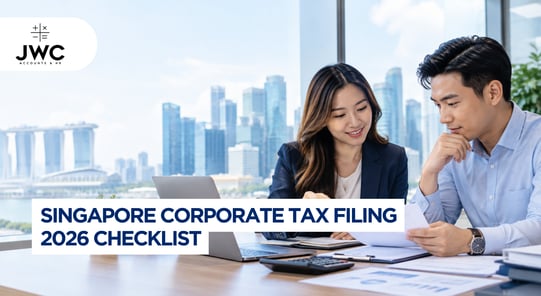
The corporate tax filing deadline can arrive quickly, especially for small and medium-sized businesses managing finance alongside day-to-day operations. For Singapore companies, the deadline to file the Year of Assessment (YA) 2026 Corporate Income Tax Return is 30 November 2026.
Whether your company is preparing Form C-S, Form C-S (Lite) or Form C, getting your records organised early can help make the process more manageable. This checklist explains what to review, which documents to prepare and common mistakes to avoid before submitting your return to the Inland Revenue Authority of Singapore (IRAS).
1. Know the YA 2026 Corporate Tax Filing Deadline
All companies must file their YA 2026 Corporate Income Tax Return by 30 November 2026, unless IRAS has granted a waiver. This applies even if a company did not carry on business or incurred a loss during the relevant financial year, unless it has been granted the relevant filing waiver.
The company’s directors remain responsible for ensuring the return is filed accurately and on time, even if a tax agent has been appointed. Leaving the task until the final days can create avoidable pressure if documents are missing or the person submitting the return does not have the required access.
2. Check Which Corporate Income Tax Form Your Company Should File
The correct return depends on the company’s circumstances and whether it meets the conditions for simplified filing. Review the eligibility criteria before starting your submission.
|
Return |
Who may use it |
What to prepare |
|
Form C-S (Lite) |
Singapore-incorporated companies with annual revenue of S$200,000 or below that meet all Form C-S eligibility conditions. |
Complete the six essential fields. Prepare and retain financial statements, tax computation and supporting documents; IRAS may request them. |
|
Form C-S |
Singapore-incorporated companies with annual revenue of S$5 million or below, deriving income taxable at the prevailing 17% corporate tax rate, and meeting the other eligibility conditions. |
Complete the simplified tax return. Prepare and retain financial statements, tax computation and supporting schedules; these are generally not submitted with the return unless requested. |
|
Form C |
Companies that do not qualify for Form C-S or Form C-S (Lite), and are not eligible to use the Form for Dormant Company. |
Submit financial statements, tax computation, detailed profit and loss statement, and other required supporting schedules and documents. |
|
Form for Dormant Company |
Companies that did not carry on business and had no income during the financial year, subject to IRAS requirements. |
Complete the required declarations and prepare relevant records that IRAS may require. Check the latest eligibility criteria and filing instructions. |
A company that did not carry on business and had no income in the financial year may qualify to file the Form for Dormant Company. Do not assume that inactivity automatically removes the filing obligation: a dormant company must still file the applicable form unless IRAS has granted a waiver.
If you are unsure which form applies, refer to the latest IRAS criteria rather than choosing a form based on revenue alone.
3. Gather the Documents and Records You Need
Before preparing the return, bring together the records that show how the business performed during the financial year. The exact documents required will depend on the return type and the company’s circumstances, but this checklist is a useful starting point.
- Financial statements and year-end accounts.
- Profit and loss statement and balance sheet.
- General ledger, trial balance and relevant accounting schedules.
- Sales invoices, receipts and records of other income.
- Supplier invoices, expense receipts and supporting payment records.
- Payroll records and relevant employee-related expenses.
- Records of fixed assets, purchases, disposals and capital allowance information.
- Details of donations, losses, tax reliefs, grants or other items requiring tax treatment.
- Previous-year tax computations and notices of assessment, where relevant.
- Confirm who will prepare and submit the return.
- Check that the employee or tax agent has the required Corppass role and access.
- Keep the company’s UEN or Entity ID and required login details available.
- Allow time to resolve access issues or missing authorisations.
- Save the submission acknowledgement and maintain a copy of the filed return and supporting workpapers.
Keep supporting evidence organised and easy to retrieve. Good record-keeping helps the company explain figures in its return and reduces the risk of omissions or incorrect claims.
4. Review Your Tax Computation
Accounting profit and taxable income are not always the same. A tax computation adjusts the accounting result for items that receive different treatment under Singapore tax rules.
Before filing, review whether expenses claimed are deductible, whether non-deductible items have been added back, and whether capital allowances or applicable tax exemptions have been considered correctly. The treatment of a specific expense can depend on its purpose and circumstances, so do not assume that every accounting expense is automatically tax-deductible.
IRAS highlights common filing mistakes such as claiming non-deductible expenses, understating income or overstating expenses because records are incomplete, and entering the wrong figure in the Form C-S (Lite) adjusted profit or loss field. If the company has foreign income, unusual transactions, group arrangements or other complex tax matters, consider obtaining professional advice before submission.
5. Confirm Corppass Access Before You File
Corporate tax returns are filed online through myTax Portal. Before the deadline, confirm that the person responsible for filing has the appropriate Corppass authorisation for the Corporate Tax (Filing and Application) digital service.
If a tax agent is preparing the return, agree early on the documents, approvals and submission timeline. Appointing an agent does not remove the directors’ responsibility to ensure the company meets its filing obligations.
6. Understand the Consequences of Late or Non-Filing
Missing the deadline can lead to enforcement action. Depending on the circumstances, IRAS may issue an estimated Notice of Assessment, require the estimated tax to be paid, offer to compound the offence, issue a notice requiring a director to provide information, or take further action such as issuing a summons. Late filing or non-filing may also result in penalties of up to S$5,000.
If your company is not ready, do not simply ignore the deadline. Check the available options and current IRAS guidance through myTax Portal. Extensions, where available, are subject to IRAS procedures and approval; they should not be assumed to be automatic.
7. A Practical Checklist Before 30 November
☐ Confirm the company’s YA 2026 filing obligation and deadline.
☐ Determine whether Form C-S (Lite), Form C-S, Form C or the applicable dormant-company form is appropriate.
☐ Reconcile the accounts and review financial statements.
☐ Collect invoices, receipts, payroll records and other supporting documents.
☐ Review tax adjustments, deductible expenses and capital allowance information.
☐ Check for missing income, unsupported expense claims or unusual transactions.
☐ Confirm Corppass authorisation and myTax Portal access.
☐ Agree on internal review and approval dates before submission.
☐ File the return and retain the acknowledgement and supporting records.
Frequently Asked Questions
What is the corporate tax filing deadline for YA 2026 in Singapore?
The deadline is 30 November 2026 for all companies required to file, unless IRAS has granted a waiver.
Does a company still need to file if it made a loss or did not trade?
Generally, yes. Companies must file the applicable Corporate Income Tax Return even if they incurred a loss or did not carry on business, unless they have been granted a waiver. A dormant company may have a specific filing option if it meets IRAS conditions.
What is the difference between Form C-S and Form C?
Form C-S is a simplified return for eligible Singapore-incorporated companies with annual revenue of S$5 million or below that meet the other conditions. Form C is for companies that do not qualify for the simplified forms or applicable dormant-company filing option.
Can a tax agent file the return for my company?
A company may authorise a tax agent to handle filing, but the required Corppass authorisation must be in place. Directors remain responsible for ensuring that the company files accurately and on time.
What happens if my company misses the deadline?
IRAS may take enforcement action, including issuing an estimated Notice of Assessment, imposing a composition amount or taking further legal steps, depending on the circumstances. Check current IRAS guidance promptly if the deadline has been missed.
Make Corporate Tax Preparation More Manageable With JWC Accounts & HR
Corporate tax filing involves more than completing an online form. Businesses need organised records, a clear understanding of their filing requirements and enough time to review the information before submission. For SMEs managing finance alongside daily operations, preparing early can help reduce last-minute pressure.
JWC Accounts & HR supports businesses with practical accounting and business administration services. If your company needs help organising its accounting records or preparing for tax-related requirements, speak with our team about the support that may be suitable for your business.